Getting to the Core: Understanding the Root Cause Approach in Functional Medicine

Why the Root Cause Approach Matters for Your Health

The root cause approach is a systematic method to identify and address the fundamental underlying causes of health problems, rather than just suppressing symptoms. Unlike conventional medicine that often treats surface-level symptoms with medications, this approach investigates why illness develops in the first place—examining factors like genetics, environment, lifestyle, nutrition, stress, and toxic exposures—to create personalized treatment plans that resolve problems at their source.
Key differences between root cause and conventional approaches:
Root Cause Approach | Conventional Symptom Management |
Asks "Why is this happening?" | Asks "What will suppress this?" |
Investigates underlying triggers | Focuses on symptom relief |
Aims to prevent recurrence | Manages ongoing symptoms |
Personalized, multi-system evaluation | Protocol-driven, single-system focus |
Addresses lifestyle, environment, nutrition | Primarily pharmaceutical interventions |
Have you ever found yourself repeatedly asking doctors "Why?" when dealing with chronic illness—only to receive another prescription instead of answers? You're not alone. Many patients with conditions like fibromyalgia, autoimmune diseases, chronic pain, or unexplained fatigue find themselves trapped in a cycle of symptom suppression without ever discovering what's actually driving their illness.
The root cause approach flips this script entirely. Instead of viewing symptoms as problems to eliminate, it sees them as clues pointing toward deeper imbalances. A headache isn't just treated with pain medication—it becomes a starting point for investigating sleep quality, stress levels, nutrient deficiencies, hormonal imbalances, food sensitivities, or environmental triggers.
This investigative mindset comes directly from root cause analysis (RCA), a problem-solving methodology originally developed in manufacturing and quality control. When applied to healthcare, it transforms how we understand chronic illness. Rather than accepting that "you'll need to manage this condition for life," the root cause approach asks whether addressing fundamental imbalances might resolve the condition entirely.
The shift from reactive to proactive management makes all the difference. Reactive medicine waits for problems to emerge, then suppresses them. Proactive medicine identifies the conditions that allow problems to develop, then changes those conditions. It's the difference between mopping up water from a leaking pipe versus actually fixing the pipe.
For patients with complex, multi-system conditions that don't fit neatly into conventional diagnostic categories, this approach offers something conventional medicine often cannot: a framework for understanding how seemingly unrelated symptoms connect to common underlying triggers.
The chronic fatigue, brain fog, joint pain, digestive issues, and mood problems that baffle conventional specialists suddenly make sense when viewed through a root cause lens examining factors like chronic inflammation, mitochondrial dysfunction, hormonal imbalances, or toxic exposures.
I'm Dr. Yoon Hang Kim, a triple board-certified integrative medicine physician with over two decades of experience applying the root cause approach to complex chronic conditions through functional medicine, helping patients with conditions like fibromyalgia, autoimmune disorders, MCAS, and Long COVID identify and address the fundamental drivers of their illness.
My clinical work combines systematic root cause investigation with evidence-based integrative therapies, including Low-Dose Naltrexone (LDN), medical acupuncture, and metabolic optimization to help patients achieve lasting wellness rather than temporary symptom relief.

What is Root Cause Analysis (RCA) and Why is it Critical?
At its heart, Root-cause analysis is a structured problem-solving method used to identify the "root" of an issue. We often use the analogy of a weed in a garden: if you only snap off the leaves (the symptoms), the weed will inevitably grow back. To get rid of it for good, you must pull it out by the roots.
In the context of health, Embracing a Root Cause Healthcare Approach for Lasting Wellness is critical because chronic illness is rarely caused by a single, isolated factor. Instead, it is usually the result of a "perfect storm" of triggers.
Research shows that systematic problem-solving can dramatically compress the time it takes to find solutions. For example, Medibank's Digital Labs team used these approaches to reduce their innovation cycles by 75%, moving from six months to just six weeks.
The importance of this method is even recognized at the regulatory level. Organizations like OSHA and the EPA emphasize the FactSheet: The Importance of Root Cause Analysis During Incident Investigation to prevent catastrophic failures in industry. In medicine, we apply that same rigor to prevent "failures" in human health.
The distinction between reactive and proactive management is vital:
Reactive Management: Treating a symptom after it appears (e.g., taking an ibuprofen for a recurring headache).
Proactive Management: Identifying the systemic reasons the headache occurs (e.g., discovering a magnesium deficiency or a hidden food sensitivity) and addressing them to prevent future pain.
Core Techniques: The 5 Whys and Fishbone Diagrams
To find the root cause, we use specific tools that help us dig through layers of symptoms. Two of the most effective are the 5 Whys and Fishbone diagrams.
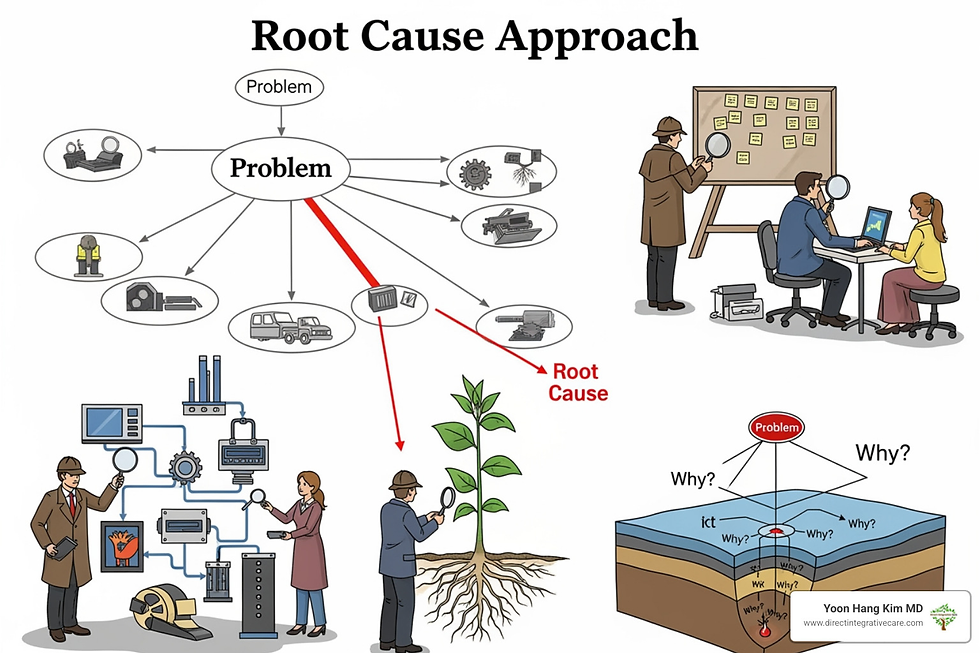
The 5 Whys approach is often called the "annoying toddler approach." Just like a child who keeps asking "Why?" until they reach the absolute bottom of a topic, we use iterative questioning to peel back the layers of a health concern.
Similarly, the Ishikawa diagram, or Fishbone diagram, provides a visual map of cause and effect. This helps us see how different categories—like environment, nutrition, and genetics—might all be feeding into a single symptom.
This is particularly useful in complex cases, such as A Functional Medicine Approach to Sinusitis: Treating the Root, Not Just the Symptom, where a "stuffy nose" might actually be caused by gut dysbiosis or mold exposure rather than just a local infection.
Applying the 5 Whys in a Root Cause Approach
The 5 Whys technique is deceptively simple but incredibly powerful. It involves taking a problem and asking "Why?" five times (or more) until the underlying process failure is revealed.
Consider how we might use this in Functional Medicine Approaches to Insomnia: A Root Cause Perspective:
Why can't I sleep? Because my mind is racing at night.
Why is your mind racing? Because I feel anxious and wired.
Why do you feel wired? Because my cortisol levels are high in the evening.
Why is your cortisol high at night? Because I am exposed to significant blue light and stress until 11 PM.
Why are you exposed to blue light and stress? Because I lack a "wind-down" routine and check work emails in bed. (The Root Cause: A process failure in sleep hygiene and stress management).
By avoiding assumptions and drilling down, we find a solution that doesn't just involve a sleeping pill, but a sustainable change in habits.
Visualizing Complexity with Fishbone Diagrams
While the 5 Whys are great for linear problems, health issues are often "multivariate"—meaning many things contribute at once. The Fishbone diagram allows us to brainstorm sub-causes across several categories:
People: Influence of family history or social support.
Process: Daily habits, exercise routines, and sleep patterns.
Environment: Exposure to toxins, allergens, or endocrine disruptors.
Tools/Materials: The quality of the food we eat or the supplements we take.
By mapping these out, we can see the "big picture" of a patient's health, ensuring no stone is left unturned.
Essential Steps for a Thorough Root Cause Approach
Conducting a thorough investigation requires a disciplined, step-by-step process:
Problem Definition: Clearly stating the issue (e.g., "Chronic fatigue for 6 months" rather than just "I'm tired").
Data Collection: Gathering history, lab results, and lifestyle data.
Causal Factor Identification: Identifying what makes the problem better or worse.
Root Identification: Using the tools mentioned above to find the "primary" driver.
Solution Implementation: Designing a personalized remediation plan.
RCA vs. Simple Troubleshooting
It is important to understand that the root cause approach is not the same as simple troubleshooting.
Feature | Simple Troubleshooting | Root Cause Approach |
Goal | Fix the immediate problem | Prevent future recurrence |
Focus | Symptoms and surface issues | Underlying systems and triggers |
Depth | Shallow (1-2 layers) | Deep (Multiple layers) |
Outcome | Temporary relief | Long-term resolution |
Distinguishing Root Causes from Contributing Factors
A common mistake is confusing a "contributing factor" with a "root cause." A contributing factor makes a problem more likely to happen, but it isn't the fundamental reason it occurred.
According to A Narrative Review of Methods for Causal Inference and Associated Educational Resources, identifying the root cause requires looking for the factor that, if removed, would prevent the event from happening again. We use event correlation to distinguish between things that just happened at the same time and things that actually caused the problem.
Leveraging Technology in the Root Cause Approach
Modern technology has made this process much more efficient. We use virtual white boards to collaborate with patients and other specialists, mapping out timelines and causal graphs in real-time.
AI-assisted analysis and data analytics also help us find the "needle in a haystack." In industries like telecommunications, systems manage billions of events daily; in medicine, we deal with thousands of data points from blood work and genetics. Using technology helps us answer How Can Integrative Functional Medicine Help with Complex Conditions? by identifying patterns that the human eye might miss.
Tailoring RCA Across Industries and Healthcare
The root cause approach is so effective that it is mandated in many high-stakes industries. For example:
Manufacturing: Regulated under TITLE 21 - FOOD AND DRUG, companies must investigate any non-conformance to ensure consumer safety.
Public Health: Under TITLE 42 - PUBLIC HEALTH, RCA is used for investigating patient safety incidents and outcomes.
In our practice, we use these same rigorous standards during a Functional Medicine Consultation. Whether we are looking at software bugs or biological "bugs," the logic remains the same: find the error in the system to fix the output.
Facilitating Effective and Blameless Investigations
One of the most important aspects of a successful investigation is creating an environment of "psychological safety." In many industries, the "blame game" prevents people from being honest about mistakes. If a nurse is afraid of being fired for a medication error, they might hide the factors that led to it (like being overworked or having confusing labels).
We ensure a blameless approach by focusing on the system, not the person. When we work with patients, we don't "blame" them for their lifestyle choices; instead, we look at the systemic barriers (stress, lack of time, lack of information) that made those choices inevitable. We then measure the effectiveness of those corrective actions to ensure the plan is actually working.
Frequently Asked Questions about Root Cause Analysis
How does RCA differ from simple troubleshooting?
Troubleshooting is about speed—getting things back to "normal" as quickly as possible. RCA is about depth—ensuring the problem never comes back. While troubleshooting might include mopping a floor, RCA involves fixing the leaky pipe and then using Lean Mistake Proofing to ensure the pipe is inspected regularly so it never leaks again.
What are the most common mistakes to avoid during an investigation?
Confirmation Bias: Only looking for evidence that supports what you already believe.
Jumping to Conclusions: Assuming you know the answer before you've finished the data collection.
Stopping at Symptoms: Thinking that "high inflammation" is the root cause (it's actually a symptom of something else, like an infection or poor diet).
Inadequate Data: Trying to solve a complex problem with only a few basic blood tests.
How can the effectiveness of RCA efforts be measured?
We look at several key metrics:
Recurrence Rate: Does the symptom come back?
Implementation Speed: How quickly can we put the plan into action?
Cost Savings: By fixing the root, do we save money on long-term medications and doctor visits?
Quality of Life: Does the patient feel better overall, rather than just having one symptom suppressed?
Conclusion
At Yoon Hang Kim MD, we believe that you deserve more than just a temporary fix. Our personalized, virtual integrative functional medicine practice is dedicated to the root cause approach. We limit our patient panel to ensure that we have the time and resources to conduct the deep, systematic investigations required for true healing.
Whether you are seeking Integrative Functional Medicine in San Antonio: A Holistic Path to Wellness or you are located in Florida, Georgia, Iowa, Illinois, or Missouri, we are here to help. We specialize in complex conditions and utilize innovative therapies like Low-Dose Naltrexone (LDN) to support your body's natural healing processes.
Don't settle for mopping up the floor. Let's fix the pipe together.
Comments